The IRS has released the official 2027 limits for Health Savings Accounts (HSAs) and High Deductible Health Plans (HDHPs). The increases are relatively modest this year, but they continue to give individuals and families a way to save more money tax-free for future medical expenses.
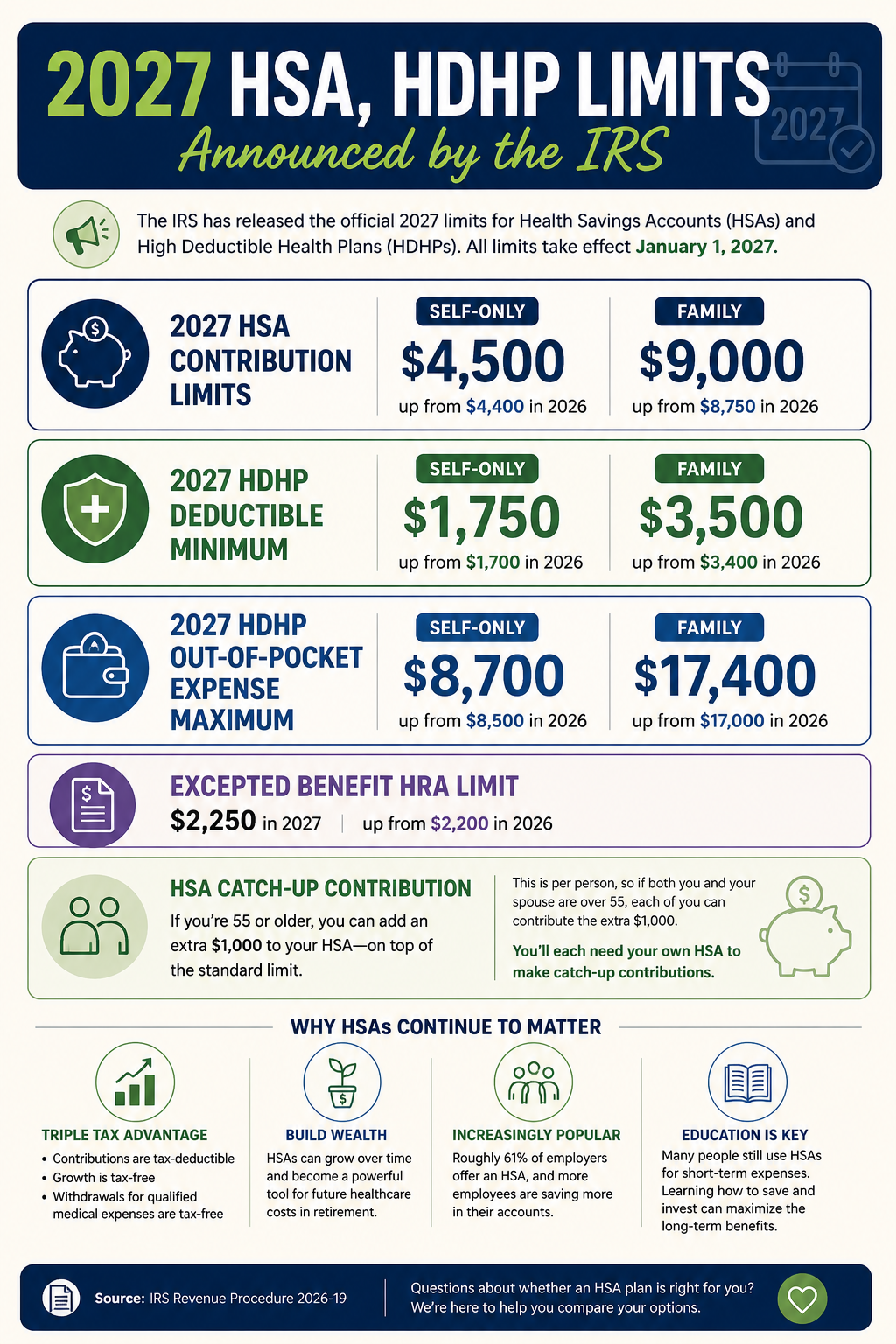
2027 HSA Contribution Limits:
- Self-Only: $4,500 (up from $4,400 in 2026)
- Family: $9,000 (up from $8,750 in 2026)
2027 HDHP Deductible Minimum:
- Self-Only: $1,750 (up from $1,700 in 2026)
- Family: $3,500 (up from $3,400 in 2026)
2027 HDHP Out-of-Pocket Expense Maximum:
- Self-Only: $8,700 (up from $8,500 in 2026)
- Family: $17,400 (up from $17,000 in 2026)
The IRS also announced that the maximum amount available through an Excepted Benefit HRA will increase to $2,250 in 2027, up from $2,200 in 2026.
All of these limits take effect January 1, 2027.
If you’re 55 or older, there’s also a $1,000 catch-up contribution allowed on top of the standard HSA limit. This is per person, so if both you and your spouse are over 55, each of you can contribute the extra $1,000. Just keep in mind that you’ll each need your own Health Savings Account to make catch-up contributions. They can’t both be deposited into the same HSA.
One of the biggest changes over the past couple of years is that HSA-qualified plans have become much more common. Prior to recent federal changes, HSA plans had stricter rules that often made them more expensive than similar Bronze plans. Now Catastrophic and Bronze plans on the marketplace qualify for HSA contributions, making it easier for consumers to take advantage of these accounts.
HSAs remain one of the few accounts in the tax code that receive what many call a “triple tax benefit”:
- Contributions are tax-deductible.
- Investment growth is tax-free.
- Withdrawals for qualified medical expenses are tax-free.
That combination makes HSAs useful not only for current medical expenses, but also as a long-term savings tool for future healthcare costs in retirement.
What’s interesting is that most people still use their HSA primarily as a checking account for medical bills. Industry surveys continue to show that many account holders spend their HSA funds as expenses occur rather than investing the money for the future. There’s nothing wrong with that, but for people who can afford to leave the funds untouched, an HSA can become a powerful retirement planning tool.
These updates come from IRS Revenue Procedure 2026-19.